bybit
Leverage, Margin and Liquidation on Bybit
- Difficulty
- Intermediate
- Time
- 2 min
On this page
Bybit lets you trade perpetuals with leverage — controlling a position larger than your margin — up to around 100x on major pairs. This page covers how leverage, margin and liquidation work on Bybit; for the underlying mechanics, start with the Leverage & risk hub.
How much leverage Bybit offers
Leverage on Bybit runs from 1x up to 100x on the major contracts (BTC, ETH, SOL — confirmed via its live API; the "125x" some older reviews cite no longer applies). Two things to know:
- The maximum varies by pair, and
- it steps down as your position grows (risk limits) — large positions can't use the top multiplier.
Smaller altcoin perps are commonly capped at 25x or 12.5x, and spot margin goes up to 10x. BTCUSDT alone has 35 risk-limit tiers: the top 100x applies only up to ~2,000,000 USDT of position value, stepping down to 1x at the largest sizes.
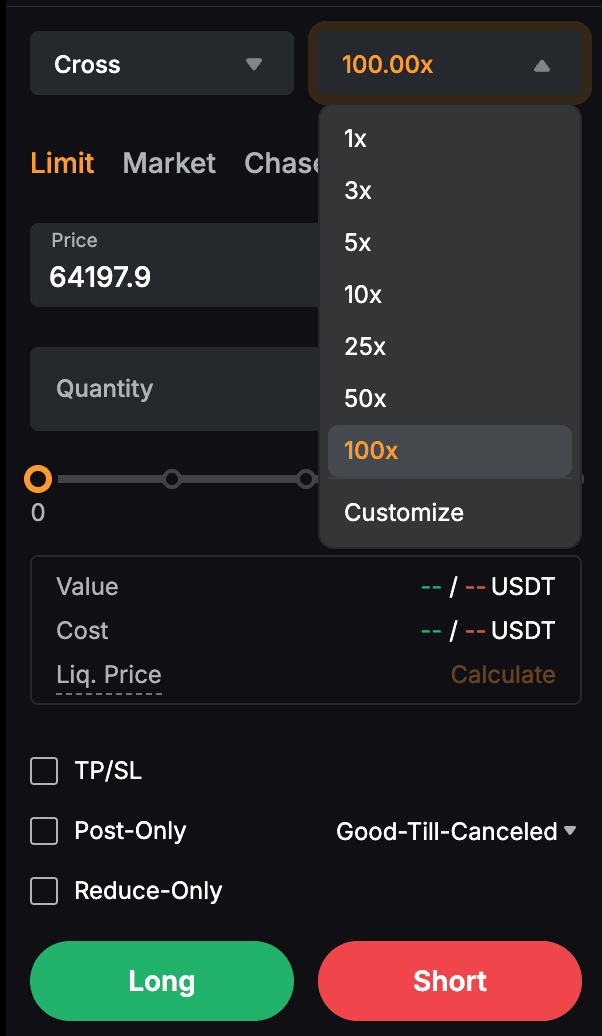
- 1Cross or Isolated margin — chosen per position (see the next section).
- 2Leverage from 1x up to 100x (or Customize). 100x is the ceiling on majors — and it steps down for larger positions.
- 3Higher leverage pulls the liquidation price closer to your entry.
Cross vs. isolated margin on Bybit
Bybit lets you back a position with isolated margin (risk capped to the amount you assign) or cross margin (your whole balance backs it). The trade-off is the same on any exchange — covered in Cross vs. isolated margin — and you choose per position.
How Bybit calculates your liquidation
Here's the detail most traders get wrong: Bybit liquidates against the mark price, not the last traded price. The mark price is an averaged "fair" value, so a brief, manipulated wick on the order book is far less likely to liquidate a position the broader market never actually moved against. Read your liquidation price from the mark price.
When losses eat past your maintenance margin, the position is force-closed at the liquidation price; Bybit also runs a derivatives insurance fund (reported around $400M, publicly viewable) and, in extremes, auto-deleveraging, to absorb liquidations that can't fill cleanly. The general concept — and how to stay clear of it — is in What is liquidation?.
A worked example
At 10x, $100 of margin controls a $1,000 position — so a 10% move against you wipes the margin and triggers liquidation. Drop to 3x and the market needs to move roughly 33% against you first. Same trade, very different survival room: leverage is the dial that sets how close your liquidation sits. Work out your own (also on the standalone PnL calculator):
Liquidation price calculator
- Approx. liquidation price
- $90.50
- Distance from entry
- 9.50%
Approximate, isolated margin — excludes fees and funding and ignores per-exchange formula details. Verify your platform's exact liquidation formula. Educational tool only, not financial advice.
Lowering your liquidation risk on Bybit
- Use less leverage — it pushes the liquidation price away from your entry.
- Add margin to an isolated position to give it more room (it lowers effective leverage).
- Set a stop-loss tighter than the liquidation price so you exit on your terms.
New to any of this? Start with the Leverage & risk hub, and mind the funding cost while a leveraged position is open.
Frequently asked questions
Related guides
Is Bybit Available in Canada? (No — Here's What to Use)
No — Bybit exited Canada in 2023 after an OSC settlement and doesn't serve Canadian residents. Here's what happened, why, and the CSA-registered exchanges Canadians use instead.
Is Bybit Legal in India in 2026? FIU Status and Tax
Yes — as of 2026 Bybit is legal in India and FIU-IND registered. What the 2025 ban actually changed, what you can trade now, and how the flat 30% crypto tax works.
Bybit Fees Explained: Spot, Futures, Deposits and Withdrawals
A clear breakdown of Bybit's trading fees — spot and futures maker/taker rates, funding, deposits and withdrawals — laid out in a dated table.
Bybit Funding Rate Explained: It's Not a Fee
What Bybit's funding rate is, how often it's charged, when you pay vs receive, and why it isn't a fee Bybit collects — with a worked example.
Written & tested by
The TradeCookbook team tests crypto exchanges and forex brokers on real, funded accounts and documents each step with original, dated screenshots. Every guide is fact-checked against primary sources and updated as platforms change.
- Hands-on testing on real, funded accounts
- Original, dated screenshots — never stock imagery
- Claims fact-checked against primary sources