crypto-futures
Perpetual Futures Explained: How Crypto Perps Work
- Difficulty
- Beginner
- Time
- 2 min
On this page
A perpetual future — a "perp" — is a crypto derivative that lets you trade an asset's price, with leverage and no expiry date. It's the most-traded instrument in crypto: flexible enough to hold indefinitely, but leveraged enough that risk management is the whole game.
Perps vs. spot vs. dated futures
- Spot — you buy and own the coin. Simple, no leverage, no expiry.
- Dated future — a contract that expires and settles on a set date; its price converges to spot at expiry.
- Perpetual — a contract with no expiry, kept close to spot by a funding rate instead of a settlement date.
Perps dominate crypto-derivatives volume precisely because they remove the expiry friction of dated futures while keeping shorting and leverage. For the bigger picture, start with Crypto futures, explained.
How leverage works on a perp
You post margin — a fraction of the position's value — and the exchange lets you control a larger position. The multiplier is your leverage: at 10x, a 10% adverse move wipes your margin and the position is liquidated (force-closed). Higher leverage means a closer liquidation price and less room for the market to breathe. The full mechanics live in the Leverage & risk hub.
The funding rate, briefly
Because a perp never settles, the funding rate keeps it anchored to spot: a small payment exchanged between longs and shorts every few hours. Positive funding means longs pay shorts; negative means the reverse. It's a recurring cost of holding a position — covered in full in What is the funding rate?.
Mark price vs. last price
Perps are valued against a mark price — an averaged, manipulation-resistant "fair" price — rather than the last trade. Your unrealized profit and, critically, your liquidation are measured against the mark price, so a single exchange's brief wick is far less likely to close your position unfairly.
Where to trade perps
The general flow is the same across reputable venues: fund a derivatives wallet, pick a perp market, set conservative leverage, choose long or short, place a stop-loss, and watch your liquidation price and funding. Doing it step-by-step on a specific platform — the screens, the fees, the order types — is what our platform walkthroughs cover.
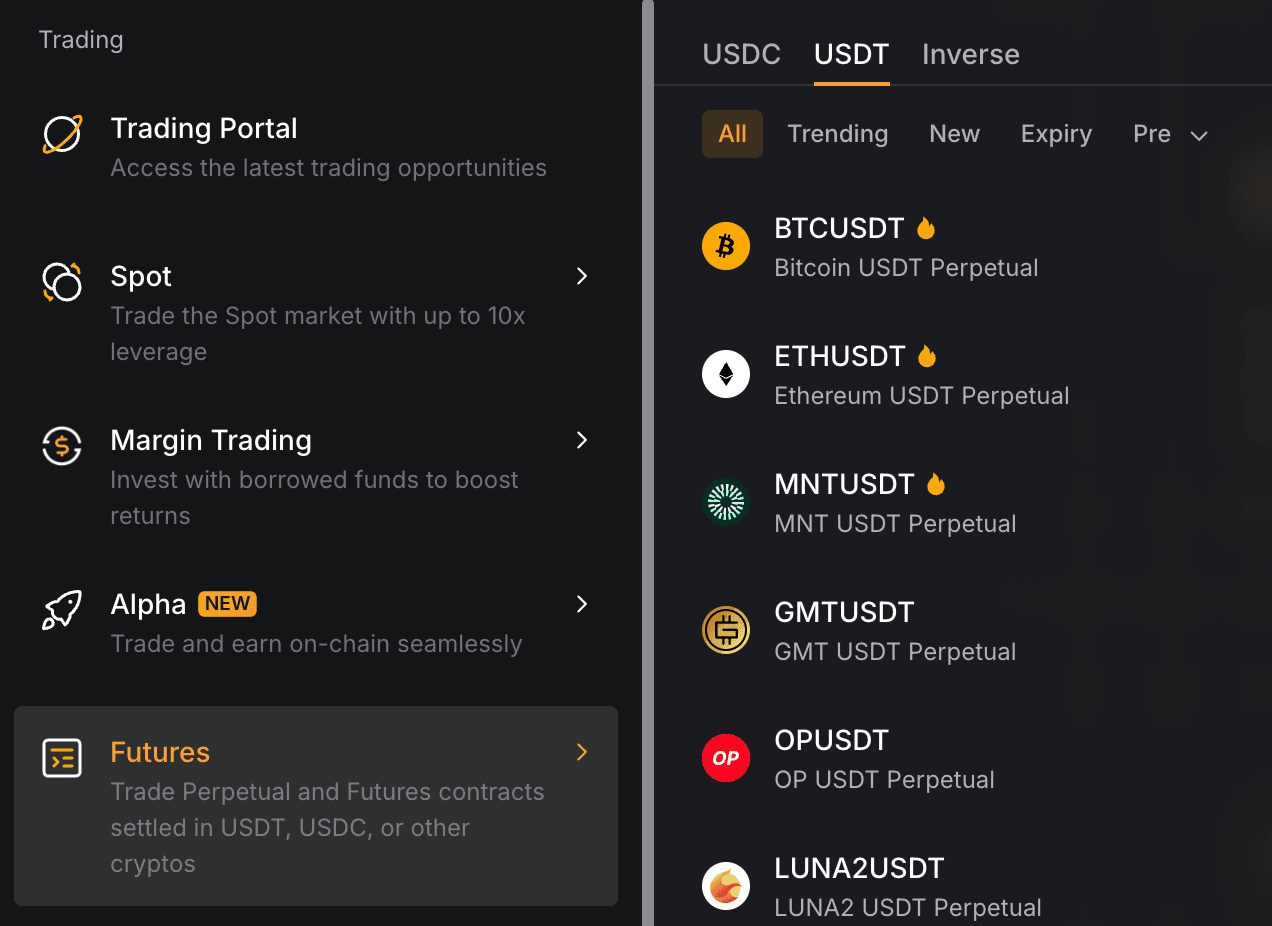
- 1USDT-settled, USDC-settled and Inverse (coin-margined) perps.
- 2Each is a 'Perpetual' — no expiry date, held to spot by the funding rate.
Ready to put this into practice?
Pick up where the theory ends — our hands-on, screenshot-by-screenshot Bybit guides are tested on real accounts.
Frequently asked questions
Related guides
What Is the Funding Rate in Crypto Futures?
Funding rates explained: what they are, why perpetual futures use them, when you pay vs receive, and how to factor funding into a trade.
What Is Open Interest in Crypto Futures?
Open interest explained: what it measures, how it differs from volume, and how to read rising or falling open interest alongside price.
Written & tested by
The TradeCookbook team tests crypto exchanges and forex brokers on real, funded accounts and documents each step with original, dated screenshots. Every guide is fact-checked against primary sources and updated as platforms change.
- Hands-on testing on real, funded accounts
- Original, dated screenshots — never stock imagery
- Claims fact-checked against primary sources